

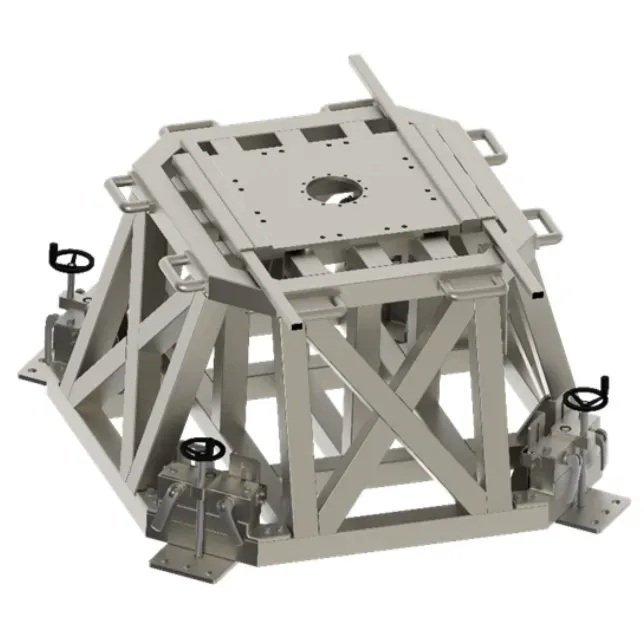
The weight and center of gravity (CG) of a system directly affect many design decisions, from flight stability and transport safety to assembly fixtures and firing accuracy. In defense and aerospace projects these values are not only calculated but also verified by measurement. This article explains why CG measurement matters, how it is done and what to consider when designing measurement equipment.
Why Does the Center of Gravity Matter?
- Flight stability: for missiles, munitions, UAVs and aircraft payloads, the CG position determines stability and controllability.
- Handling and lifting safety: lifting points and transport equipment are selected according to the CG.
- Platform integration: systems mounted on vehicles, ships or aircraft must stay within the balance limits of the platform.
- Dynamic performance: in rotating and moving systems (e.g. pan tilt units, weapon platforms), the distance of the CG from the rotation axis affects motor load and vibration.
Calculated vs. Measured Values
The CAD model gives a good estimate during design, but cables, adhesives, paint, fasteners and manufacturing tolerances change the real value. That is why weight and CG are verified by measurement on prototypes and production parts in critical systems.
How Is It Measured?
Reaction force (load cell) method
The part is placed on three or more load cells at known positions. The force at each point is measured; the total force gives the weight and the moment balance of the forces gives the CG position in the horizontal plane.
Vertical center of gravity
To find the vertical CG coordinate, the part is tilted by a known angle or measured again in a different orientation. The third coordinate is calculated from the moment difference between the positions.
Additional mass properties
Some applications also require moments of inertia and products of inertia; these are usually measured with an oscillation (pendulum) method.
Key Points in Measurement Equipment Design
- Range and accuracy: load cells are selected for the heaviest and lightest parts to be measured.
- Fixtures and reference points: the part must be positioned repeatably with a defined coordinate system.
- Stiffness: deflection of the platform under load causes measurement error and is verified by structural analysis.
- Calibration: regular calibration with reference masses and measurement uncertainty calculation.
- Safety: for sensitive loads such as munitions, grounding, securing and operator safety are part of the design.
- Software and reporting: measurement results are recorded and reported traceably.
PROMEC's Approach
PROMEC Engineering designs and manufactures weight and center of gravity measurement equipment for defense industry projects. The mechanical structure is developed by our mechanical design team, and stiffness and strength are verified with structural analysis. Contact us to discuss your measurement needs.